

Metal injection molding (MIM)
Metal injection molding (MIM) is a metalworking process in which
finely-powdered metal is mixed with binder material to create a "feedstock"
that is then shaped and solidified using injection molding.
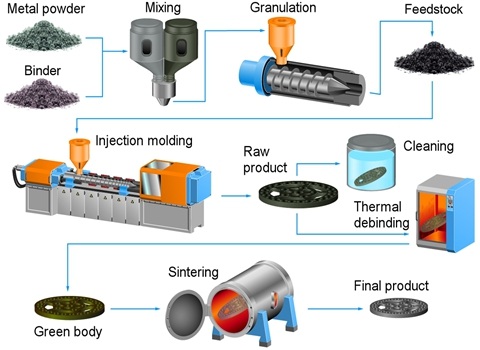
The process steps involve combining metal powders with polymers such as wax and polypropylene binders to produce the "feedstock" mix that is injected as a liquid into a mold using plastic injection molding machines. The molded or "green part" is cooled and ejected from the mold. Next, a portion of the binder material is removed using solvent, thermal furnaces, catalytic process, or a combination of methods. The resulting, fragile and porous (40 volume percent "air") part, is in a condition called the "brown" stage. To improve handling often the debinding and sintering are combined into a single process. Sintering heats the powder to temperatures near the melting point in a protective atmosphere furnace to densify the particles using capillary forces in a process called sintering. MIM parts are often sintered at temperatures nearly high enough to induce partial melting in a process termed liquid phase sintering. For example, a stainless steel might be heated to 1350 to 1400 degrees Celsius). Diffusion rates are high leading to high shrinkage and densification. If performed in vacuum, it is common to reach 96–99% solid density. The end-product metal has comparable mechanical and physical properties with annealed parts made using classic metalworking methods. Post sintering heat treatments for MIM are the same as with other fabrication routes, and with high density the MIM component is compatible with the metal conditioning treatments such as plating, passivating, annealing, carburizing, nitriding, and precipitation hardening.
There is a broad range of materials available when utilizing the MIM process. Traditional metalworking processes often involve a significant amount of material waste, which makes MIM a highly efficient option for the fabrication of complex components consisting of expensive/special alloys (cobalt-chrome, 17-4 PH stainless steel, titanium alloys and tungsten carbides). MIM is a viable option when extremely thin walls specifications (i.e., 100 micrometers) are required. Additionally, electromagnetic interference shielding requirements have presented unique challenges, which are being successfully attained through the utilization of specialty alloys (ASTM A753 Type 4)